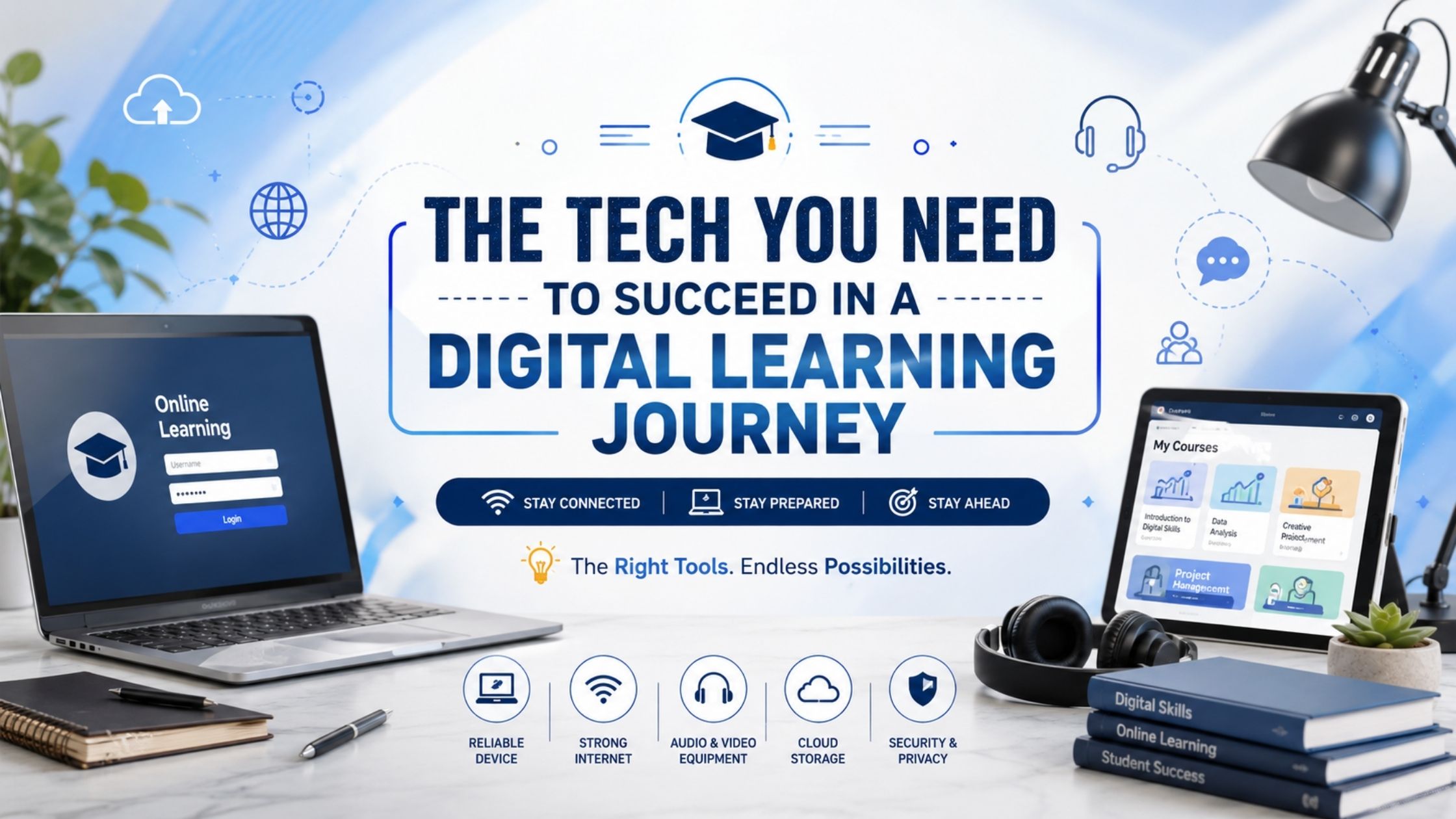
I am going to tell you about my excitement before enlisting in my first online study program. Meanwhile, I was concerned about the technologies that I would require. I wondered whether my laptop was fine enough, and my Internet connection was quick enough. I did some research and found that it takes a few basic tools to get students going.
A digital study programme is a study programme that can be learned online, instead of in a classroom. We have online lessons, do homework, join in the discussions and take quizzes. Utilising the correct technology makes learning easier and avoids technical issues.
What Is a Digital Study Program?
Digital study program: a study program that is completed online. Teaching is delivered via websites or learning applications, rather than in a classroom. Certain classes are conducted live, and some are for self-paced learning.
There are a growing number of schools, colleges and training centres providing digital learning. It provides students with greater flexibility of study since they may study from their homes or nearly anywhere with an internet connection.
Top Essential Hardware for Digital Learning
First of all, I want a device that I can use reliably. A laptop computer is typically best as it can be used to write, research and attend online meetings. If I study at home, a desktop computer is also suitable.
A tablet is useful for taking notes and watching videos is a tablet. Others, however, are more easily accomplished using a full keyboard on a computer.
It helps to have a smartphone to read messages, announcements, and for short conversations. However, I cannot trust a phone to be used for all of my tasks as this screen is smaller.
Even if faced with technical or study problems, some students look for online class help. I always test my device before seeking any support.
Internet Requirements for a Digital Study Program
The Internet is one of the most crucial learning tools when it comes to online learning. Slow Internet speeds can cause disruptions to live lessons and uploading assignments.
Video classes and streaming require at least 25 Mbps of download speed, according to many experts. A faster plan could work better if you’re using the same internet connection at home with several people.
I always keep my distance from my Wi-Fi router, if I can. Sometimes a weak signal will be picked up by moving closer to it – if cost is not a factor.
Software You May Need
A program that assists a computer in running various functions. All digital study programs employ software in some manner.
Most students need:
- A browser (e.g., Chrome or Edge)
- A word processor to type assignments in. A word processor to use for assignments.
- A PDF reader
- Video meeting software
- Cloud-based storage for storing files.
It enhances performance and security to keep software updated. Always do updates before important exams/classes.
Learning Management Systems, You Should Know
An LMS or ‘Learning Management System’ is a website used by the school to organise online courses. All lessons, assignments, grades and announcements are stored in one location.
Some of the more popular learning platforms include Moodle, Canvas, Blackboard and Google Classroom. Each system is somewhat different, but they all permit students to easily access the learning material.
My students check my LMS daily. This is something I do that helps me when I have to submit things on time or when I have to receive messages from my teachers.
AI Tools That Can Support Digital Learning
Artificial Intelligence, also known as AI, is a technology that helps computers to do things that would normally need a human thinker to do. AI can respond to queries, elaborate on subjects, summarise content and offer ideas.
Use AI to master concepts that I can’t or don’t understand, or to plan my study. But I don’t rely on it for every job I do. Always verifies information through trustworthy learning materials and my course materials.
Allow AI to assist us with learning, not thinking. Responsibly, it enables us to acquire new skills and do our own homework honestly.
Technology Requirements by Course Type
There is a variety of different technologies required for different courses. Simple subjects tend to only require a computer, Internet and easy software. English, history and business courses are included. Some courses will need more robust devices. Graphic Design students may require editing Software.
Coding programmes are frequently used by computer science students. Depending on the course, simulation software may also be required for the science courses. Prior to enrolling in a course, I always first read the technology requirements of my school.
Mobile Technology for Studying Anywhere
Learning is flexible with the use of mobile devices. I can view lessons, read notes and view announcements on my smartphone or tablet. This is helpful when travelling and when I am away from home.
I love having my mobile device, but for long assignments, I’d love to have my laptop. It’s easier and more comfortable to write with the bigger screen and full keyboard.
In fact, some pupils use an online class taker in case they have hectic schedules. I feel it would always be better to establish good study habits and effective time management.
Accessories That Improve the Learning Experience
It is easy to make online learning much easier with the use of small accessories. The only thing I’m looking for is a few helpful things that will enhance my study time, but I don’t require a lot of expensive equipment.
Helpful accessories include:
- A comfortable headset (with a microphone)
- A wireless mouse
- A web camera to use in video classes.
- A laptop stand
- A notebook used to record fast notes.
A device to store power for studying outside the house. A power bank while studying outside the house. These handy tools are very useful for helping me to keep my head on straight during long lessons, and are simple to make.
Digital Skills Every Online Student Should Develop
Good technology is just one component of successful online learning. I need to be able to use basic computer skills, also.
These skills consist of making documents, uploading assignments, attending video conferences, emailing, and sorting documents into folders. It also saves time daily by learning some of the keyboard shortcuts.
Another quite significant skill is good time management. I have an appointment book and reminders to ensure that I don’t miss deadlines.
Cybersecurity Tips for Digital Students
Cybersecurity is taking measures to ensure that devices and personal information are secure against online threats. It should be a thing which every student is familiar with.
I always have a robust password and never share it with anyone. I also always enable 2 Factor Auth if available, as it provides additional security.
Never click on links or open attachments that I don’t know. Additionally, maintaining up-to-date anti-virus (AV) software helps to safeguard my computer from harmful software.
Common Technical Problems and How to Solve Them
There will be technical issues for pretty much everybody. Fortunately, some of the solutions to this are simple.
Restart the router if the internet is slow; move closer to the Wi-Fi signal if slow. When the app freezes, I close it and open it again. I come back around to my computer and often find that issues that only affect a small part of the software have been solved.
If I don’t know how to resolve a problem, I will seek assistance from my school’s technical support staff before it becomes a problem in my classroom.
There is additionally an increasing number of online class help services that learners will try when they have trouble with tough classwork. I always ensure that any support that I use is adherent to the school’s academic rules.
Budget-Friendly Technology Options for Students
Not always have to use the most up-to-date computer for internet study. There are lots of good laptops that are low in cost for standard learning.
It is possible to purchase a refurbished laptop, which will be more budget-friendly but still deliver good performance. The free software, cloud storage and public library Internet access options are also ways for students to save money.
Before purchasing technology, review the prices for comparison to help keep within budget.
Accessibility Technology for Inclusive Learning
Students with other learning needs can access the learning more easily with accessibility technology. These are the tools that help to bring digital education to a wider audience.
Students with visual impairments use screen-readers, speech-to-text, closed captioning for videos and adjustable text-size. These are other features that are quite useful, which many learning platforms provide.
The use of accessibility tools enhances the learning experience for all.
Future Technology Trends in Digital Education
Technology is continually getting better every year. AI is increasingly being used in the world of education. Virtual reality and augmented reality are also making lessons more interactive!
The use of cloud learning, online customised learning platform and smarter learning apps will likely gain even more popularity. These will be used to enable students to learn in ways that suit their needs and learning styles.
Digital Study Program Technology Checklist
I make sure that I have all the necessary materials ready before I take an online class.
My checklist includes:
A portable computer, or a computer desk, is necessary.
- Stable internet connection
- Updated web browser
- Word processing software
- Video meeting application
- Access to Learning Management System (LMS)
- Headset and microphone
- Backup file storage
- Strong passwords
- Study schedule
If you can do the following things before school starts, you will save time in troubleshooting technical issues and have more time for learning. Searching for and paying for services such as take my online class for me or take my class online when feeling helpless can get quite difficult for some students, but with proper preparation, practice and the right technology, online learning is quite rewarding and easier.